Out of the 786 Latin American auto parts businesses we analyzed on Google Maps, 58.6% (461 companies) do not have their own website, and only 31.2% (245 businesses) have an independent website that loads properly. Furthermore, when we ran a technical test across 1,407 company websites in the sector, we found that 8.3% failed to load or returned critical errors—and among the homepages that did work, nearly half lacked a clickable WhatsApp button and two-thirds failed to include a clear call to request a quote.
If you own an auto parts store, import company, or wholesale distribution business in Bolivia, Peru, Ecuador, Colombia, Chile, or Uruguay, these numbers point to a clear reality: while your buyers are searching for parts on their phones every day, most businesses in the industry remain hard to find or difficult to contact online. Below, we break down the exact state of auto parts websites in your country and what a practical website needs to turn visitors into real inquiries.
Buyers Are Already Searching Online, But the Digital Counter Is Empty
Before diving into our study's findings, it is helpful to look at how repair shops, fleet managers, and vehicle owners across Latin America buy parts today. Public industry data confirms that the purchasing journey now begins on a smartphone screen:
- Google is the primary gateway: According to Statcounter Global Stats (2026), Google holds a 90.78% search engine market share in South America. When a mechanic or purchasing manager needs an urgent replacement part or looks for a new supplier, their first move is to search the part name, vehicle brand, or OE code on Google.
- Everything happens on mobile: According to the Mobile Economy Latin America report by GSMA (2024), unique mobile subscriber penetration across Latin America has reached 72% of the population. Buyers are searching right from the repair bay or parts counter with their phones in hand.
- Online auto parts demand is surging: According to industry figures shared by Mercado Libre during Expopartes and reported by Revista Autocrash (2025), Colombia's online auto parts market was projected to grow 27% in 2025.
- Widespread digital lag among SMEs: Despite this buyer behavior, the United Nations Economic Commission for Latin America and the Caribbean (ECLAC / CEPAL, 2025) reports that 96% of small and medium-sized businesses in the region have no web presence at all, and among the small fraction that do, 73% maintain a purely passive presence without active online services.
How does this digital gap play out specifically in the automotive aftermarket? At PartsTrade, we decided to measure it firsthand.
Country-by-Country Breakdown: How Many Auto Parts Stores Have Their Own Website?
Within our broader research dataset of 5,531 Latin American auto parts companies, we examined a specific sample of 786 businesses verified on Google Maps to see what a buyer encounters when searching locally:
- 58.6% (461 out of 786) do not have an independent website with their own domain.
- 51.1% (402 out of 786) did not list any website URL at all on their Google Maps profile.
- 59 companies linked only to a social media page instead of a website; out of those, 49 used Facebook.
- Most importantly: out of all 786 businesses in this sample, only 31.2% (245 companies) have an independent website that opens without errors.
When we break down independent website ownership by country within our Google Maps sample, the contrast across markets is striking:
| Country | Businesses Analyzed (Maps Sample) | With Own Website | Percentage with Own Website |
|---|---|---|---|
| Chile | 206 | 157 | 76.2% |
| Colombia | 95 | 49 | 51.6% |
| Uruguay | 30 | 10 | 33.3% |
| Peru | 69 | 22 | 31.9% |
| Ecuador | 92 | 23 | 25.0% |
| Bolivia | 293 | 63 | 21.5% |
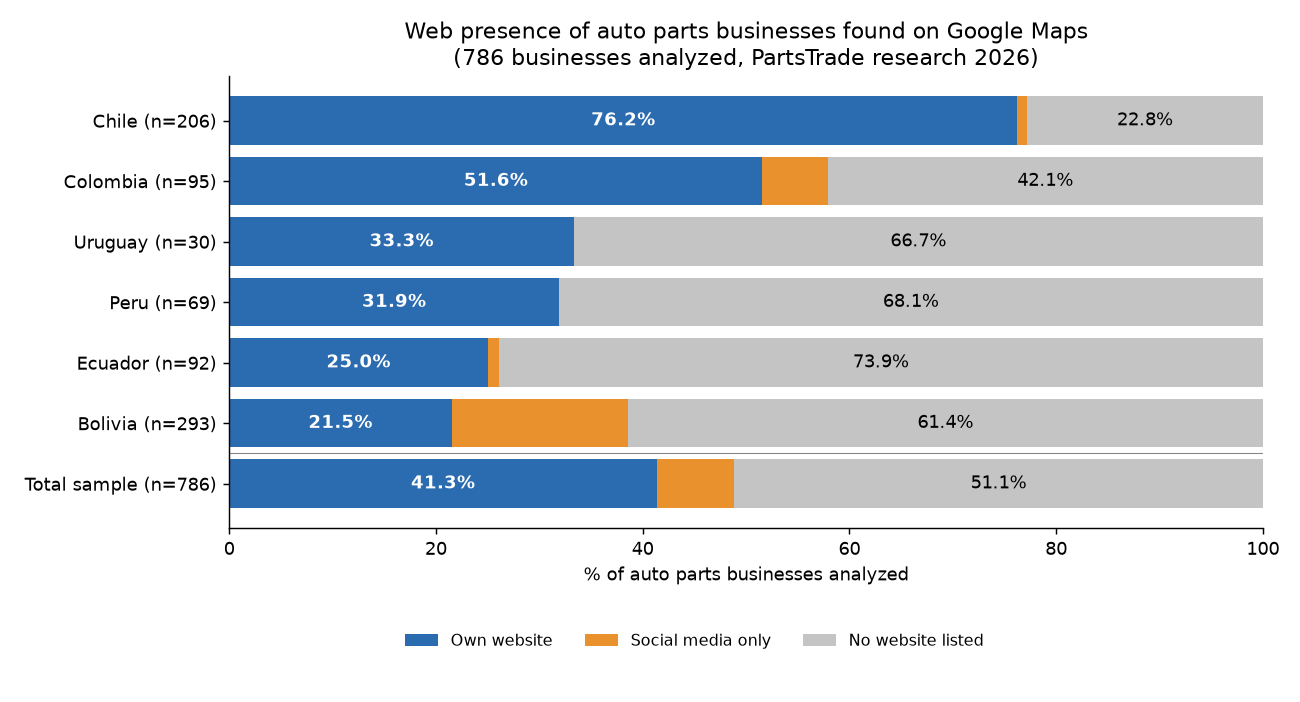
As the table illustrates, while roughly 3 out of 4 analyzed businesses in Chile have their own domain, just over half do in Colombia. In Uruguay and Peru, roughly two-thirds of the analyzed businesses lack an independent site. And in active import markets like Ecuador (25.0%) and Bolivia (21.5%), about 3 out of 4 analyzed businesses in Ecuador and nearly 8 out of 10 in Bolivia have no website of their own.
Having a Website Isn't Enough: Why Many Existing Sites Fail
Many business owners assume that because they paid someone to set up a website a few years ago, their digital presence is taken care of. However, our technical audit shows that simply owning a domain does not mean customers can actually view your catalog or request a price.
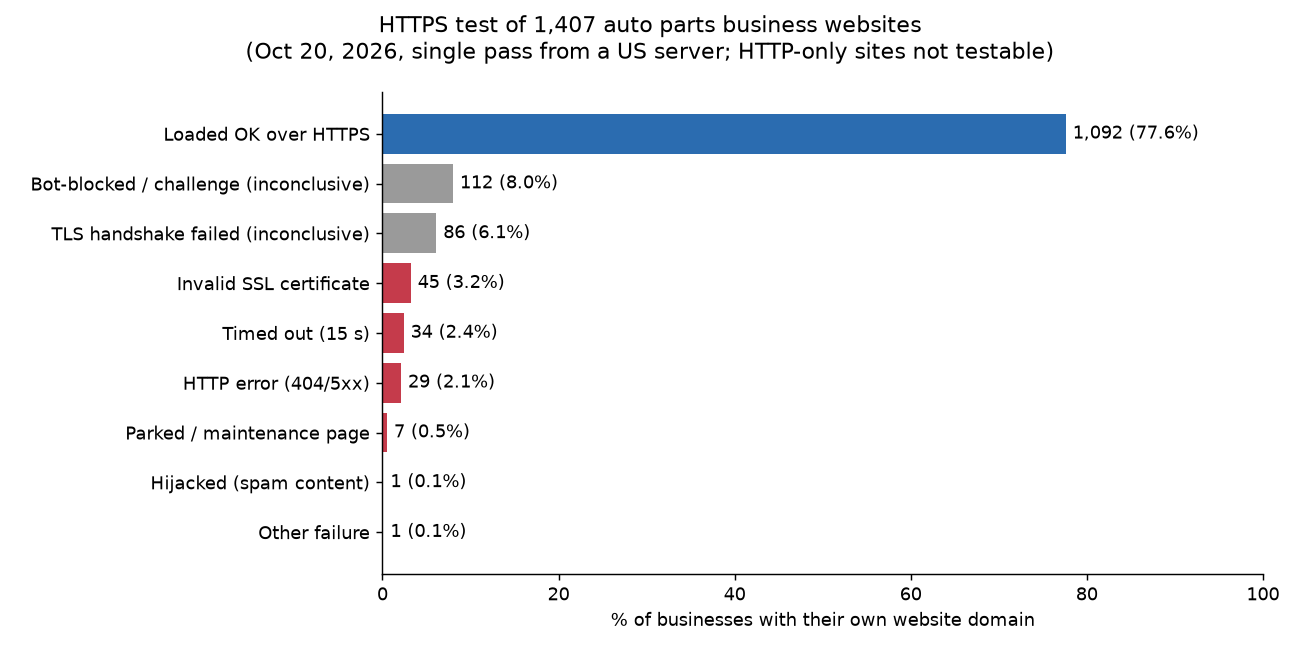
In the second phase of our study, we ran a live technical test on the websites of 1,407 auto parts companies from our database. We discovered that 8.3% (117 websites) were completely unreachable or returned severe errors:
- 45 websites had expired or invalid security certificates (SSL/HTTPS), triggering a bright red "Your connection is not private" browser warning that immediately drives buyers away.
- 34 websites timed out completely due to server failure or extreme slowness.
- 29 websites returned direct HTTP server or "page not found" errors.
- 7 websites led to parked domains or permanent "under construction" pages.
- 1 website had been hijacked and redirected to a gambling site, and 1 website failed due to other connection errors.
What About the Websites That Actually Load?
We closely inspected the 1,025 homepages that opened properly to see how well they are set up to handle an auto parts buyer. The results explain why so many existing websites fail to generate sales inquiries:
- Mobile-friendly layout (the one bright spot): 97.8% included basic mobile viewport configuration. Since modern web templates adjust to phone screens by default, mobile responsiveness is no longer a differentiator—it is simply the baseline.
- Missing WhatsApp links: Only 53.4% featured a clickable WhatsApp button or link on their homepage. That means 46.6% of working websites force the buyer to manually copy and paste a phone number or fill out a clumsy contact form that rarely gets a fast reply.
- No clear invitation to request a quote: Only 38.1% included a clickable email link, and just 34.0% used clear commercial call-to-action words like quote / request a quote (cotiza / cotización / presupuesto) on their homepage.
In the auto parts trade, buyers rarely check out silently with a credit card without asking questions first. A repair shop or wholesale buyer needs to confirm stock, verify fitment by brand, model, year, OE part number, or VIN, and check delivery times. If your website acts like a static digital brochure without an obvious "Request a Quote on WhatsApp" button, you are losing leads every single day.
What a Good Auto Parts Website Should Have in 2026
To work like a 24/7 sales counter, your website does not need flashy animations or a complicated e-commerce checkout system that your team has no time to maintain. Instead, a high-converting auto parts website needs five practical essentials:
- Fast loading with valid HTTPS security: A site that opens quickly without browser security warnings immediately signals that your company is established and trustworthy—both to local buyers and overseas partners.
- Built for a mechanic's smartphone: Clear typography, straightforward navigation, and lightweight pages that load fast on mobile data inside a workshop.
- Prominent WhatsApp quote buttons from the very first screen: Your homepage and product sections should feature a direct, one-tap button to your sales WhatsApp. The entire goal of the website is to start a conversation with your sales counter in one click.
- A catalog organized by vehicle brand and part category: When a buyer lands on your site, they should know within five seconds whether you carry their vehicle makes (for instance, Chery, JAC, Changan, Great Wall, Geely, BYD, or the specific brands you specialize in) and which product lines you stock (engine, suspension, brakes, body parts, transmission).
- Clear Google Maps location and shipping coverage: Displaying your physical storefront address, business hours, and whether you ship nationwide builds instant credibility with out-of-town shops and new buyers.
What This Means for Your Business: Your Competitors' Gap Is Your Opportunity
Looking at these numbers—where 67% to 78% of analyzed businesses in Bolivia, Ecuador, Peru, and Uruguay lack their own website, and nearly half of working sites across the region forget to add a WhatsApp button—you might see an industry that is behind the curve. Put on your business owner's hat, however, and you will see something else: what your competitors haven't done yet is your biggest commercial advantage.
For example, imagine twenty shops on a single avenue in La Paz, Santa Cruz, Lima, Quito, Bogotá, or Santiago, all selling the exact same shock absorbers, clutch kits, or sensors. If fourteen of them don't show up with their own website on Google, three have broken websites showing security warnings, and two have no WhatsApp button, the business that puts up a clean, mobile-ready website organized by vehicle brand with a one-click WhatsApp quote button captures the buyer's inquiry.
Having your own website does not replace your Facebook page or your daily WhatsApp sales work—it strengthens them. It gives your business a permanent, professional catalog open 24 hours a day so repair shops in other cities, fleet buyers, and vehicle owners can find you on Google and message your team directly.
Our Methodology
At PartsTrade, we believe in sharing transparent, real-world market data. Here is how we conducted this study:
- Dataset and Sample Profile: The findings come from our proprietary research database of 5,531 deduplicated auto parts businesses across Latin America, of which 3,095 companies were checked for website presence between May and September 2026. Because our research focused heavily on importers, wholesalers, and retailers specializing in Chinese-brand vehicle parts, this dataset represents a targeted industry sample rather than a random sample of all auto parts stores in Latin America. Accordingly, all percentages reported reflect the exact group of companies we analyzed ("of the N companies we analyzed").
- Google Maps Sample: The country-by-country breakdown and social media analysis were conducted on a subset of 786 businesses identified via Google Maps.
- Technical Website Testing: Live website availability and homepage inspections were conducted on October 20, 2026, across 1,407 company websites (with content analysis completed on the 1,025 homepages that loaded successfully). The test was executed as a single-pass check from servers in the United States, testing HTTPS connections only and analyzing exclusively the homepage of each domain.
Preview How Your Store's Website Would Look—Before You Decide
We know that as the owner of an auto parts store or import business, you don't have weeks to waste managing freelance developers, writing copy from scratch, or building a complicated site that ends up sitting unfinished.
That is why PartsTrade works differently. Focused exclusively on the auto parts industry, we build a working preview of your business's website—tailored to the vehicle brands and part categories you actually sell, and wired for direct WhatsApp quote inquiries—so you can review it on your own phone and computer for free before making any commitment.
If you would like to see how your store or wholesale business would look with a clean, inquiry-driven web catalog, request your free preview below:
👉 See How It Works and Request Your Free Website Preview at PartsTrade